

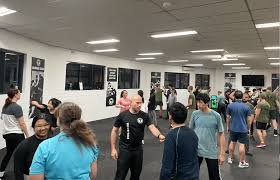
Most people don’t think about self-defence until the moment they wish they had. That’s not a criticism — it’s just human nature. We get busy, we feel safe, and the idea of spending a Tuesday night learning to break a wrist grab feels a bit extreme — until it doesn’t. SGS Krav Maga, based in Mortdale in Sydney’s south, has built its entire programme around that reality. It doesn’t promise to turn you into a fighter. It promises to give you the tools to walk away from a situation that could otherwise go very wrong.
And the way they do it is worth paying attention to.
Krav Maga Isn’t a Martial Art — It’s a Mindset
There’s a lot of confusion around Krav Maga, partly because it doesn’t look like what most people picture when they think of combat sports. There are no katas, no belt ceremonies, no stylised movements that take years to master before they become remotely useful. Krav Maga was developed for the Israeli Defence Forces — and its entire design philosophy comes from that origin. It needs to work under pressure, for ordinary people, against real threats.
That means the techniques are direct and grounded in body mechanics that don’t require exceptional strength or athletic ability. It means training scenarios are built around situations you might actually face — a grab from behind, an aggressive confrontation in a car park, a threat involving a weapon. It means the mental side of self-defence gets as much attention as the physical. Awareness, de-escalation, decision-making under stress — these things are woven into the SGS approach from day one.
The PowerKube Combat Performance Centre: Training That Goes Beyond Technique
One of the things that sets SGS Krav Maga apart from a standard martial arts school is the PowerKube Combat Performance Centre. If you haven’t encountered one before, it’s worth understanding what it brings to a training environment.
The PowerKube is an interactive training system — essentially a smart target system that measures response time, accuracy, and striking power across a range of drills. It turns what could be a fairly repetitive striking session into something that pushes you cognitively as well as physically. You’re not just hitting a bag and hoping for the best; you’re tracking your performance, identifying patterns, and developing the kind of sharp, reactive movement that actually holds up when adrenaline is running high.
For the fitness side of things, it’s genuinely effective. You’ll work hard. But more importantly, you’re building functional conditioning — the kind that translates to real-world performance rather than just looking good in a gym mirror.
Women’s Self-Defence Classes: Practical, Not Patronising
SGS Krav Maga runs dedicated women’s self-defence classes, and the distinction matters. Not because women need to be separated from the broader training environment — they absolutely don’t, and many women train in the regular classes with excellent results — but because a women-only space removes a particular layer of self-consciousness that can slow people down at the start.
The content is also calibrated. The scenarios women statistically face most often — grabs, holds, threats from someone known to them — get specific attention. So do the psychological dimensions: the hesitation, the shock, the internal resistance to acting assertively in a threatening situation. Good self-defence training has to address all of that, not just the physical mechanics.
What you won’t find here is the patronising tone that sometimes creeps into programmes marketed to women — the assumption that you’re fragile, or that the goal is simply to make you feel better rather than actually give you skills. SGS keeps it grounded and practical.
Training for All Ages — and Why That’s Harder Than It Sounds
Offering effective training across different age groups isn’t just a matter of scheduling different classes. It requires a genuine understanding of how people learn and move at different stages of life — and a willingness to adapt the curriculum without watering it down.
SGS Krav Maga has programmes for juniors, adults, and older students, and the approach shifts appropriately across those groups. Younger students build confidence, coordination, and situational awareness alongside basic defensive skills. Adults get a more intensive, scenario-heavy programme. Older students benefit from techniques that don’t rely on speed or power they may not have, focusing instead on leverage, positioning, and avoidance.
There’s also something worth noting about what training like this does beyond self-defence. The discipline, the focus, the process of learning something physically challenging — these things have spillover effects. Kids who train tend to carry themselves differently. Adults who train regularly report improved stress management and better sleep. It’s physical education in the fullest sense of the phrase.
Safety First — in Every Sense
There’s an irony that sometimes gets pointed out about self-defence training: you have to be safe while learning to defend yourself. It’s a fair point. Poorly run martial arts or combat training environments can result in injuries that are entirely avoidable — and that’s counterproductive for everyone.
SGS Krav Maga takes a structured approach to this. Technique is introduced progressively, with controlled drilling before anything resembling live pressure. Instructors monitor intensity and contact carefully, particularly with newer students. The goal is to challenge people — to put them under realistic-enough stress that the training has genuine value — without putting them at unnecessary physical risk.
This balance is harder to strike than it looks. A training environment that’s too comfortable doesn’t prepare you for anything. One that’s too aggressive drives people away and causes harm. Getting it right takes experience and good coaching judgment — which is what you’ll find at SGS.
Real Situations, Not Theoretical Ones
One of the most consistent feedback points from SGS students is that the training feels relevant. Not abstract, not stylised, not disconnected from the kinds of situations you might actually encounter. That’s not accidental — it reflects a deliberate curriculum choice.
Scenarios are built around real environments: confined spaces, low light, multiple people, verbal aggression before it turns physical. Students practise recognising threat cues early enough to create distance or de-escalate. They learn that the best self-defence outcome is usually the one where nothing physical happens at all — and that getting to that outcome requires awareness and composure as much as any physical technique.
When physical responses do need to be trained, they’re kept close to reality. No flying kicks, no tournament-rules sparring, no techniques that depend on a compliant partner who stands still. The messy, unpredictable nature of actual confrontation gets built into the training from fairly early on.
The Mortdale Community Angle
SGS Krav Maga isn’t a franchise dropped into a suburb with no local roots. It’s part of the Mortdale community, and that matters in ways that are easy to underestimate. When the instructors know the area, they understand the context their students are training in. When the gym has been there long enough to build relationships with families, you get a different atmosphere than you do in a transient, high-turnover training environment.
For parents considering training for their children, that community dimension is often the deciding factor. They’re not just sending their kids to learn how to hit things — they’re entrusting a local institution with their child’s development, in a fairly significant way. SGS has earned that trust over time.
Is It For You?
That depends on what you’re looking for. If you want a competitive sport with rankings and tournaments, Krav Maga probably isn’t your answer — there are better options for that. If you want a belt progression system with ceremony and tradition, same story.
But if you want to be less vulnerable in the world — to move through daily life with more confidence, more awareness, and more practical capability if something goes wrong — then SGS Krav Maga in Mortdale is worth your time. The training is honest, the environment is serious without being intimidating, and the skills you build are the kind that actually hold up when the pressure is real.
Sometimes the most useful thing you can invest in is the thing you hope you’ll never need.
