

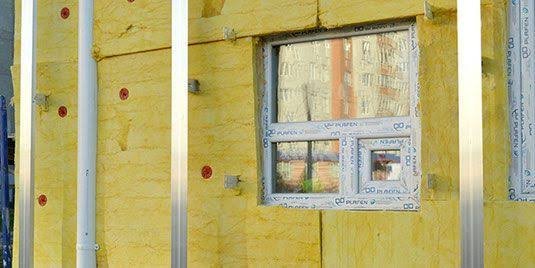
Anyone who has pushed a building permit through in Spain over the last few years knows the Código Técnico de la Edificación no longer accepts “we added insulation” as an answer. Every solution now has to be backed by test certificates and calculations a technical architect can defend in front of a colegio review or a site inspection. In Valencia, where summer heat runs from May through October and much of the industrial stock was built before any of these requirements existed, the gap between what’s standing and what’s now demanded is particularly visible. Firms like Acusfoc, working daily with fireproof, acoustic, and thermal insulation across new builds and renovations, run into that gap on nearly every job — and the three disciplines rarely show up one at a time.
Fire: the part that leaves no room for shortcuts
The Basic Document on Fire Safety (DB-SI) within the CTE classifies materials under the European standard EN 13501-1, ranked from A1 (non-combustible) down to F. In an industrial shed or a multi-family residential block, that classification decides what can go into a ventilated façade, a suspended ceiling, or the space around service ducts. This isn’t cosmetic: a poorly classified insulation product inside a services shaft can turn that void into the path a fire uses to jump between floors within minutes.
What usually fails isn’t the material itself — it’s the joint sealing and the way services pass through walls and floor slabs rated for fire resistance (EI 60, EI 90, EI 120, depending on use and building height). A perfectly built firebreak wall loses its entire function if a cable or pipe penetration gets packed with ordinary polyurethane foam instead of a certified intumescent sealant. Renovation projects in 1970s and 1980s buildings around Valencia run into this constantly: the structure holds up fine, but the service penetrations were never designed with compartmentation in mind. Getting this right usually means auditing every duct, cable tray, and pipe run against the fire sector plan before anyone touches the walls, rather than discovering the gaps once the inspector shows up.
Noise: what DB-HR has required since 2009
The Basic Document on Noise Protection has been in force for over a decade, yet it’s still the chapter of the CTE that produces the most surprises at handover. It requires at least 50 dB of airborne sound insulation between dwellings, plus specific values for party walls next to common areas, plant rooms, or ground-floor commercial units. In Valencia, with so many mixed-use buildings — shops at street level, housing above — that last point sparks more than a few neighbour disputes once a bar or a gym moves in below a flat and nobody checked beforehand whether the slab actually complies.
The fix is almost never “add more mineral wool.” Impact noise gets solved with floating floors on a perimeter elastic band, while airborne noise depends on both the mass of the partition and the decoupling between its two leaves. A well-executed independent lining, physically separated from the original wall, outperforms doubling the thickness of insulation glued directly to it. That’s the difference between a lab test result and what a sound meter actually reads once the keys are handed over — and it’s exactly the gap that turns up in post-occupancy complaints when the design assumed lab conditions that the site never delivered.
Thermal performance: real savings, not just compliance
The Basic Document on Energy Saving (DB-HE), updated in 2019 to push the existing building stock toward nearly-zero-energy performance, sets maximum thermal transmittance values by climate zone. Valencia city falls into zone B3, stricter than most people assume given the Mediterranean climate: long summers mean controlling both winter heat loss and summer solar gain, something poorly installed insulation or unresolved thermal bridges simply can’t achieve on their own.
Thermal bridges at slab-to-façade junctions, in shutter boxes, or around window frames account for a share of energy consumption that no efficiency label captures once site execution drifts from the design. This is where a specialist installer earns their keep over a generic solution: coordinating façade insulation with roof insulation and exterior joinery avoids temperature islands that later show up as condensation and higher-than-expected heating and cooling bills.
Industrial retrofits across the Comunidad Valenciana
A good share of Acusfoc’s current demand comes not from new construction but from industrial units and business parks that need to catch up. A shed built in the 1990s, with no fire-compartmentation strategy and no acoustic treatment around machinery, may now need a full intervention to secure an activity licence or to comply with industrial fire-prevention regulations (RD 513/2017).
These projects almost always combine all three fronts at once: sandwich panels with a rock-wool core to compartmentalise fire sectors, acoustic enclosures around compressors or noisy production lines, and roof insulation to cut the thermal load in sheds that can easily top 35°C inside during summer. Treating each issue separately usually costs more in the long run than planning the full intervention from the start.
None of these three fields — fire, noise, and temperature — performs well in isolation. A building that complies on paper can still fail in practice if fire, noise, and heat are treated as separate problems rather than parts of the same construction system. For developers, owners’ associations, and industrial businesses across Valencia, working with a specialist who understands how these three requirements interact — not just how to tick each box separately — is usually what separates a building that passes inspection from one that actually performs well for the next thirty years.
